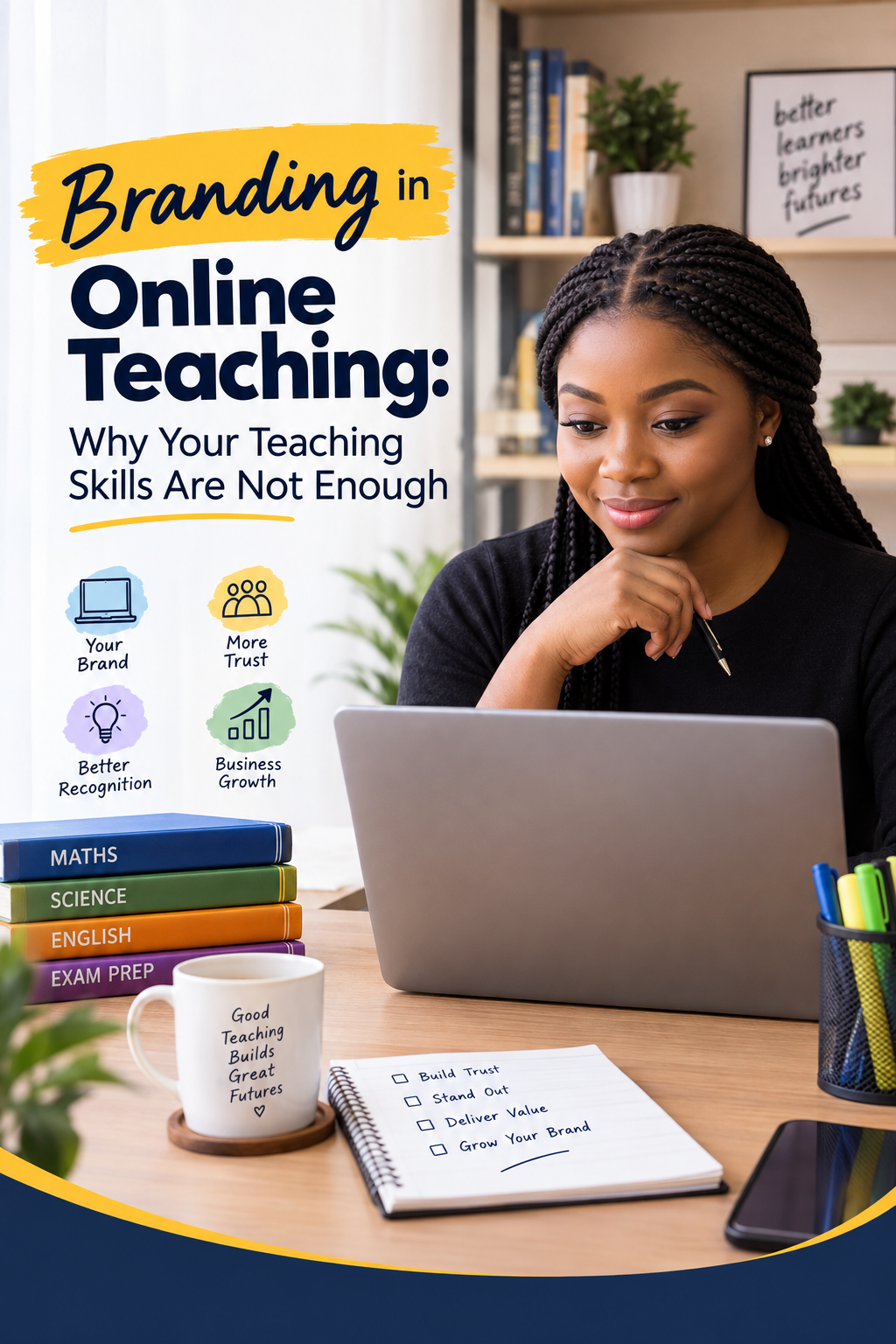
Your Online Teaching Brand: Asset or Liability? In a crowded online tutoring market, your brand is what makes parents choose you and learners remember you. It's not just a logo — it's the total experience you create, from your teaching style to your learner results. Discover the surprising factors parents use to evaluate online tutors and the simple changes you can make today to build trust and st
Online teaching has changed how educators connect with learners. A tutor can now teach a child thousands of kilometres away, share interactive resources, run assessments, keep parents informed, and build a real business — all from a laptop.
But there is a question most online tutors never stop to answer:
What does your teaching brand say about you before you even start teaching?
Being a good teacher matters. It has just stopped being the only thing that decides whether parents choose you, whether learners remember you, and whether your tutoring business grows.
Here is why that question is now urgent, and what the evidence actually says.
---
The space is crowded, and it is getting more crowded
The global online tutoring market was worth roughly $10.4 billion in 2024 and is projected to reach about $23.7 billion by 2030, growing at around 14.5% a year (Grand View Research). Different analysts put the number higher or lower depending on how they define "online tutoring," but they agree on the direction: fast growth, and a lot of new entrants.
For you, that cuts both ways. There are more parents willing to pay for online tutoring than ever before — and more tutors competing for them. When the supply of tutors goes up, subject knowledge alone stops being a differentiator. Everyone claims it. What separates you is whether a parent can tell you are good before they have ever seen you teach.
That "before" is your brand.
---
What branding actually means for a tutor
Branding is not your logo, your colours, or your flyers. Those are just the visible surface.
Your brand is the total impression someone forms when they interact with your teaching service — before, during, and after a lesson. It includes your visual identity, your teaching style, your communication, your platform, your materials, your professionalism, your relationship with parents, and — above all — the results you produce.
In one sentence: your brand is the experience people associate with your teaching.
A tutor can have excellent subject knowledge, but if the messages are late, the worksheets look thrown together, and there is no way to see whether the child is improving, a parent will quietly conclude the whole service is disorganised. Fairly or not, people judge the invisible thing (teaching quality) by the visible things (how everything around it is handled).
---
Why it matters: what parents actually weigh
This is where most branding advice waves its hands. Here is what the research on parent decision-making actually shows.
Trust is the deciding factor. When parents compare online and offline tutoring, the single biggest hesitation about online is trust — they cannot physically watch you the way they could a tutor sitting at their dining table (Think Academy). Everything you do online is either building that trust back or leaking it. Your job is to replace the reassurance of physical presence with visible, consistent professionalism.
Before booking, a parent typically looks at some mix of your profile, your website or social pages, your reviews and testimonials, your qualifications, and how you communicate in the first message. Study after study on choosing an online tutor names the same short list: qualifications, testimonials and reviews, clear communication, curriculum fit, and evidence of progress tracking (Curious Jr, Eduxpand, JustTutors). Notice how few of those are about raw subject knowledge. Most of them are brand signals.
Memorability compounds. There are thousands of tutors online, and most present themselves identically: "Experienced maths tutor, all levels, affordable rates." If your presentation looks like everyone else's, a parent scrolling through options has no reason to remember you an hour later. A recognisable colour, a consistent tone, a clear teaching philosophy — these are not vanity. They are how you stay in someone's memory long enough to be chosen. The goal is not to look flashy. The goal is to be recognisable.
---
Your brand lives in every touchpoint — including the boring ones
Here is the part tutors underestimate. Your brand is not a page on a website. It is every point of contact a family has with you.
Your teaching materials are brand touchpoints. Two tutors teach the same topic. Tutor A sends a plain, inconsistent worksheet. Tutor B sends a clean, well-structured resource with consistent fonts, clear instructions, and an engaging activity. The teaching may be equally good — but the second experience feels more organised, and parents pay for how it feels as much as for what it is.
Your live lesson is a brand touchpoint — and there is a specific trap here. Guides that teach parents how to spot a weak online tutor now warn them explicitly about the "slide reader": the tutor who opens a PDF or a static slideshow and simply reads it aloud with little interaction (Eduxpand). Parents are being coached to treat passive teaching as a red flag. So questioning, live working, a shared whiteboard, and getting the learner to do rather than watch are no longer just good pedagogy — they are now part of how a parent judges whether you are worth the money.
Your follow-up is a brand touchpoint. Does the learner get feedback or a task after the lesson? After a few weeks, can the parent actually see progress? Which leads to the most useful expectation you can set...
Set the timeline honestly. Meaningful improvement from tutoring typically takes about 6 to 8 weeks of consistent sessions, not one or two (Tutopiya). Most parents do not know this, and many quietly give up after a couple of sessions because they expected an overnight jump. A tutor who says this upfront — "here is roughly when you should expect to see change, and here is how we will track it" — instantly sounds more credible than one who over-promises. Managing expectations is branding. It signals that you know how learning actually works.
---
Define what you want to be known for
Before you touch a logo, answer this: what do I want parents and learners to remember about my teaching?
Weak positioning sounds like a job title:
"I am a Mathematics tutor."
Strong positioning sounds like a promise:
"I help learners build the confidence and problem-solving skills they need to succeed in Mathematics."
And here is a specific, evidence-backed angle: curriculum specialisation is now one of the pillars parents explicitly evaluate (Eduxpand). A tutor who can credibly serve a defined framework — KS2 SATs, GCSE, WAEC, NECO, JAMB — is easier to choose than a generic "all levels" tutor, because the parent can immediately see the fit. If you can serve more than one framework well (for example, both UK and Nigerian curricula), that is not a footnote — it is your headline. It answers the exact question a parent is already asking: "Does this person understand the specific exam my child is sitting?"
Do not bury your differentiator. Lead with it.
---
Make it consistent across platforms
If you have a website, an Instagram page, a Facebook page, a WhatsApp Business profile, and a teaching portal, they should feel like the same person is behind all of them.
They do not need to look identical. They do need consistency in your name, logo, colours, fonts, messaging, profile information, and tone. When a parent meets your brand in three different places and it feels like three different businesses, trust drops. When it feels like one coherent operation, trust builds — quietly, before you have said a word.
---
Use technology to show progress, not to show off
Technology gives online tutors tools that in-person tutoring never had: interactive lessons, online assessments, learner dashboards, automated progress reports, digital assignments, educational games, and parent-communication systems.
But notice which of those maps directly onto what parents said they were looking for: progress tracking. That is the single most underused brand asset available to a tutor. A parent who can log in and see their child's scores climbing over six weeks does not need to be convinced you are effective — they can watch it happen.
So the question is never "how many tools can I use?" It is "which tool makes the learning visible to the person paying for it?" A clean progress report beats a flashy animation every time.
Also worth saying plainly: none of this rescues weak teaching. A beautiful logo cannot fix poor communication, and impressive posts cannot fix poor results. Technology and design amplify what is already there. They do not replace it.
---
Your results are your strongest brand asset
Everything above attracts attention. Only one thing turns attention into a reputation: outcomes.
Learner improvement, parent satisfaction, testimonials, referrals, and exam results are what actually compound over time — and testimonials and reviews, remember, are one of the first things a new parent checks. This is the flywheel:
Your brand attracts attention. Your teaching earns trust. Your results build reputation — and reputation brings the next parent, who checks your reviews, and starts the cycle again.
Which is exactly why chasing branding instead of teaching quality is a dead end. The two only work together.
---
Start small
If your brand feels scattered right now, you do not need to rebuild everything this weekend. Start with the basics and let them compound:
- Define what you want to be known for — one clear promise, not a list of subjects.
- Choose a simple, consistent visual identity — a couple of colours and fonts you use everywhere.
- Upgrade your teaching materials — consistent formatting is the cheapest professionalism you can buy.
- Make your communication clean and prompt — first-message quality is a first impression.
- Put up a simple, honest online presence — clarity beats complexity.
- Track and show learner progress — this is your credibility, made visible.
- Ask satisfied parents for testimonials — they are doing your marketing for you.
- Set realistic expectations — tell parents about the 6–8 week reality before they ask.
None of these require money. They require consistency. And consistency, repeated over months, is a brand.
---
Final thought
Online teaching is no longer about transferring knowledge through a video call. It is about creating an educational experience — one a parent can trust before the first lesson and point to after the tenth.
So if you are building an online tutoring career, do not only ask:
"How can I teach better?"
Also ask:
"How can I create an experience that people recognise, trust, and remember?"
Because in online education, your brand is not just what people see.
Your brand is what they experience.
---
Sources: Grand View Research (online tutoring market size, 2024–2030); Think Academy (parental trust in online vs offline tutoring); Tutopiya (typical 6–8 week improvement timeline); Eduxpand, Curious Jr, and JustTutors (how parents evaluate and choose online tutors).
Comments (1)
- J
John
14 September 2026
What an insightful Writeup